
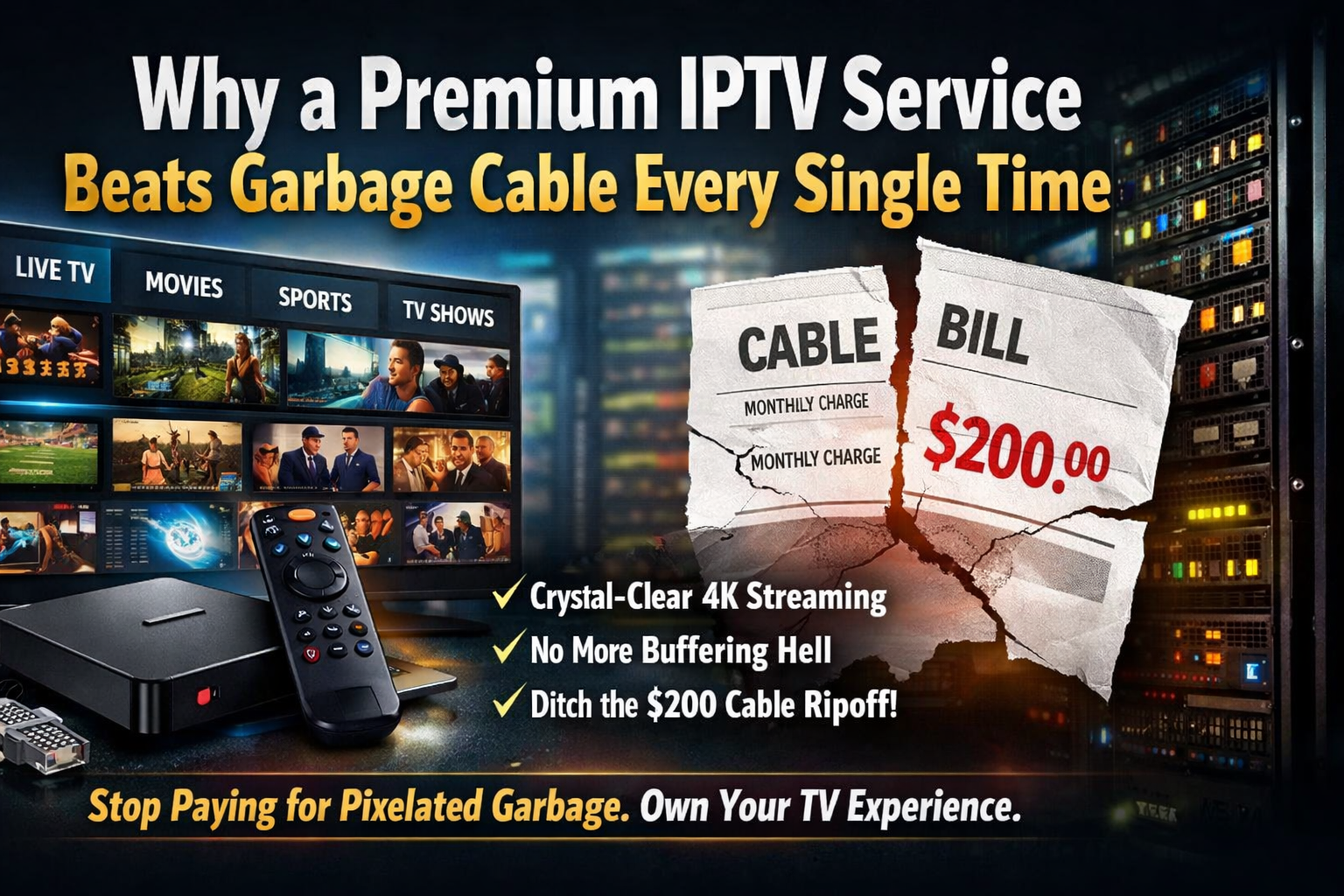
I’ve spent fifteen years staring at server racks and debugging transport streams until my eyes bled. If you’re still paying $200 a month to a legacy cable giant in the United States of America, you’re getting robbed. Plain and simple. I’m tired of seeing people settle for pixelated garbage and contracts that read like a mortgage. You want the truth? Most people think a premium iptv service is just some “hacker” thing. Wrong. It’s the only way to actually own your viewing experience in 2024.
Anyway, let’s get into the dirt. I remember sitting in a cold data center in Chicago back in 2012. We were trying to figure out why the “legit” providers had such massive latency. The answer was greed. They were routing traffic through prehistoric hardware. Today, a solid iptv stream subscription bypasses all that corporate rot. It’s lean. It’s fast. It’s what TV should have been a decade ago.
The Buffer Nightmare
You know that spinning circle? That little ring of death that appears right before a touchdown? It smells like failure. I’ve spent countless nights tracing packets to find out why a stream drops. Usually, it’s not the “internet.” It’s the provider overselling their bandwidth. Cheap providers cram 10,000 users onto a server built for 500. Absolute mess. But fixable.
A real premium iptv service invests in high-end CDNs. They don’t cheap out. When you use something like Streaming Services, you’re paying for the stability. You’re paying for the fact that I don’t have to get a frantic call at 3 AM because the European servers melted. Here’s the thing: if it’s free, you’re the product. If it’s $5, the server is a toaster in someone’s basement.
Gear Matters More Than You Think
Stop using that five-year-old smart TV app. Just stop. Those processors are jokes. They can’t handle the HEVC decoding required for a high-bitrate smart stream tv setup. I always tell my friends: get a dedicated box. Something with some actual guts. You wouldn’t put cheap tires on a Ferrari, right?
I’ve seen people try to run 4K streams on a stick that costs less than a sandwich. It gets hot. It throttles. Then they blame the provider. Look, the hardware is the bridge. If the bridge is made of wet cardboard, you aren’t crossing the river. Use a device that supports hardware acceleration. Your eyes will thank you.
The Search for Sanity
There are thousands of streaming services out there. Most are junk. They buy a “restream” package, slap a shiny logo on it, and call themselves a provider. They have no control over the source. When the source goes down, they just shrug. I hate that.
True expertise is about source control. You want a provider that owns their encoders. I’ve been in rooms where we’ve hand-tuned the bitrate for individual sports channels to make sure the grass doesn’t look like green mud. That’s the difference. It’s the sweat. It’s the obsessive tweaking of parameters that most people don’t even know exist.
Stop Falling for the “100k Channels” Lie
“We have 150,000 channels!” No, you don’t. You have 5,000 channels and 145,000 dead links. It’s a marketing gimmick for suckers. Who watches a local news station from a city they can’t pronounce? Nobody.
Give me 500 channels that actually work. Give me 1080p at 60fps so the hockey puck doesn’t disappear into a ghost-trail. That’s what a premium iptv service actually delivers. Quality over quantity. Always. I’ve pruned lists for hours just to get rid of the “filler” that slows down the EPG (Electronic Program Guide). A bloated EPG is a slow EPG. Slow is bad. Fast is king.
The “On-The-Job” Reality Check
People ask me all the time, “Is it worth the headache?”
Here is my take. If you enjoy being told what to watch and when to watch it by a company that hates you, stick with cable. But if you want to see what happens when engineers actually care about the signal, you move. I’ve watched the shift happen. I’ve seen the “big guys” scramble to build their own apps that still feel like they were designed in 1998.
But wait, there’s a catch. You need a VPN. I’m not saying this because I’m selling them. I’m saying this because ISPs in the United States of America love to throttle “unrecognized” video traffic. They see a high-bandwidth stream and they squeeze it. It’s dirty. A VPN hides that signature. It keeps the pipe open.
Final Thoughts from the Trenches
I’ve lived and breathed this stuff for over half my life. I’ve seen the rise and fall of “magic boxes” and “lifetime” subs that last three weeks. Trust the guys who have grease on their hands. Look for the providers that talk about “uptime” and “peering” instead of “deals” and “discounts.”
At the end of the day, a premium iptv service is about freedom. It’s about not having a technician show up between 8 AM and 4 PM only to tell you your wall outlet is “old.” It’s about clicking a button and seeing a crisp, clear image immediately. It’s been a long road to get here. But the tech is finally ready for prime time. Don’t settle for the corporate garbage. You deserve better.
Frequently Asked Questions
What is the best way to stop buffering on IPTV? Hardwire your device. Seriously. Wi-Fi is fine for scrolling on your phone, but for a high-bitrate stream, interference is a killer. Use an Ethernet cable. If you must use Wi-Fi, use the 5GHz band and stay close to the router.
Do I really need a VPN for IPTV in the USA? Yes. ISPs are aggressive about managing their network loads. They often throttle high-traffic streams that don’t come from their “approved” partners. A VPN prevents them from seeing what you are doing, which often results in a much smoother experience.
Why do some channels look better than others? It comes down to the source. Some channels are “transcoded” (compressed) to save bandwidth, while others are “raw” feeds. A premium provider will offer raw feeds for major sports and movie channels to give you the highest possible detail.
Is it hard to set up a premium IPTV service? It used to be a nightmare involving M3U links and manual configuration. Now, most top-tier providers have dedicated apps. You just log in and watch. It’s no more difficult than setting up any other major app on your device.
Can I use one subscription on multiple devices? Usually, yes, but it depends on your plan. Most providers allow 1, 2, or 5 simultaneous connections. If you try to use more than your limit, the stream will cut out or you’ll get flagged. Always check your connection limit before sharing your login.